. . . I've been told that I write novels for email messages. Perhaps this is the way to go. I'll try to make each entry, or Gemstone, a "precious" one. On mediocre days, all I might be able to produce is a "semi-precious" entry. In any case, an entry might be a "neat" Gemstone--something that is uniquely mine.

Sunday, July 18, 2010

A Dream Like I've Never Had Before

Last night's dream was truly odd. I was on some sort of cruise ship, not alone, and we were searching for a place to eat. We ended up at one of those dinner shows and before I knew it, I was up on the stage singing! For one, I don't sing very well, and two, I'd never do it on a stage in front of an audience. I definitely have a fear of giving speeches and singing would be 10 times as scary! But there I was. I don't know what the song was, either. That would have been good to know.

So I looked up what singing in a dream meant on dreammoods.com and read the following: "To sing in your dream, represents happiness, harmony and joy in some situation or relationship. You are uplifting others with your positive attitude and cheerful disposition. Singing is a way to celebrate, communicate, embrace, and express your feelings."

Doesn't that sound good? I like it. Maybe I'm happy because I just had a wonderful vacation. Or maybe I am happy in the relationship with the person that I was with in the dream. In any case, I like to think that I've got a positive attitude and cheerful disposition. But if there's a way to communicate that in any other way besides getting up in front of an audience and singing, I'm all for that instead!

Saturday, July 17, 2010

Petrified Forest National Park

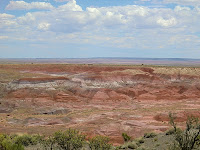
We took a detour off of I-40 as we headed east toward home yesterday and drove through Petrified Forest National Park and the Painted Desert. I've always driven straight through this stretch of Arizona but this time thought it'd be great to stop. Unfortunately, it was 100° outside so we didn't walk any long trails, preferring to drive to lookout points, getting out for pictures, and hurrying back into the air conditioned truck. Still, it was worth the extra time to go through.

Currently this portion of Arizona is a dry grasslands but about 200 million years ago during the late Triassic period it was a humid, tropical, vast floodplain that had many streams crossing it. Tall conifer trees grew along the banks would fall and the streams would wash them into the floodplains. A mix of silt, mud, and volcanic ash buried the logs. The sediment cut off oxygen and slowed the logs' decay. Over time silica-rich groundwater seeped through the logs, replacing the original wood tissues with silica deposits. Eventually the silica crystallized into quartz and the logs were preserved as petrified wood.

At the southern end of Petrified Forest National Park is a short Giant Logs Trail. Normally they say the 0.3 mile loop should take 20 minutes but I think we did it in 10 because of the heat. Still, we saw wonderful, colorful petrified wood deposits in the Chinle Formation. The colors of the logs are due to trace minerals that soaked into the wood along with the silica. Blue, purple, brown and black are caused by manganese minerals.

As you drive north along the park road you are driving toward younger deposits. At the farthest north, at Chinde Point on the Painted Desert portion of the park, the rocks are about 205 million years old. Over 10 million years of deposition occurred within the park. The views of the Painted Desert were remarkable. Next time I'd like to visit during the spring or fall when it isn't so hot!

Thursday, July 15, 2010

Sunset Crater Volcano National Monument

The third national monument we visited on Wednesday was located about 20 miles north of Flagstaff: the Sunset Crater Volcano National Monument. It is located within the San Francisco Volcanic Field on the Colorado Plateau that was active beginning six million years ago. Sunset Crater is the most recent eruption, exploding between 1040 and 1100. The Sinagua lived and farmed the area and so were witnesses to this eruption.

Sunset Crater is a cinder cone, forming when molten rock sprayed high into the air from a crack in the ground. The lava solidified and fell to Earth as large bombs or small cinders. Eruption after eruption occurred in this manner, building a debris pile up to 1,000 feet high. Two lava flows erupted near the vent, the Kana-a and the Bonito, and destroyed everything in their path. The entire event may have lasted 6 months to a year with a final eruption spewing red and yellow cinders out from the vent and onto the rim. The colorful glow from these cinders reminded people of a sunset and led to the volcano's name. The elevation at the summit is 8,029 feet with it's diameter at its base 1 mile. Approximately one billion tons of material was extruded from the vent.

We walked along a trail over the Bonito lava flow to the base of Sunset Crater. The gravel beneath our feet was black and the rocks a chunky, clinky form of lava called "aa." It is the same kind of lava flow that I walked over when on the big island of Hawaii. The rock is also known as "basalt."

The ancestors of today's Hopi people, the Sinagua, witnessed the eruption. In some Hopi accounts, the Qa'na Katsina caused Sunset Crater to erupt after people engaged in a life out of balance. The eruption is a living reminder that if people stray from their religious ideals and life, there may be another eruption.


Walnut Canyon National Monument

After we visited Meteor Crater yesterday, we went to Walnut Canyon National Monument near Flagstaff. At first all I saw as I walked the 270 steps down to the Island Trail from the visitor center were the rock layers. I noticed right away the cross bedding within the CoconinoSandstone (left) and the blocky pattern of the Kaibab Limestone that was above it. After looking more, I noticed ancient dwellings of the Sinagua built into one layer of the overhanging limestone cliffs.

In the canyon you see the layering of the Kaibab Limestone on top of the Coconino Sandstone but what you don't see right away is a limey shale layer under the limestone. Because shale is less resistant to weathering and erosion, it was carved away by flowing water, leaving the limestone overhang above it. The Sinagua built walls and fronts using the overhangs as roofs. They used blocks of limestone cemented with clay. The dwellings go back at least 10 feet and are on average 5 feet high.

The Sinagua lived in the canyon from 1125 to 1250 when the canyon was fertile. It is not clear why the people left but they moved to new villages and were eventually assimilated into the Hopi culture.

Meteor Crater

Yesterday (Wednesday) we visited another big hole in the ground, this one not formed from earth’s natural processes, but from something extraterrestrial.

Meteor crater was formed 50,000 years ago when an iron-nickel meteorite (meteors stay in the sky, meteorites hit the ground) struck what is now the Arizona desert. The meteor is estimated to have been about 150 feet across and weighed several hundred thousand tons (a 2-foot wide, 1,400-pound fragment of it is pictured, above left). It struck the land with an explosive force greater than 20 million tons of TNT. During the crater’s formation, over 175 million tons of rock were thrown out a distance of over a mile. Large blocks of limestone, the size of small houses, were heaved onto the rim and flat-lying beds of rock were overturned or uplifted as much as 150 feet.

The crater made a hole in the rocks of the Kaibab Limestone and Coconino Sandstone from 260 million years ago. The crater is over 4,000 feet across and 550 feet deep. Originally, the crater is thought to have been 700 feet deep (as tall as a 70-story building) but erosion has transferred the topsoil over time. The circumference is 2.4 miles.

How do scientists know that the crater isn’t a volcanic caldera? After all, people argued over its origin when it was first discovered in 1871. Local settlers just thought it was part of the Hopi Buttes volcanic field northeast of the site. After many years of study, scientists have concluded that it is definitely not volcanic and that it is the result of an impact. There is the presence of many meteorite fragments on the northeast side of the crater. Plus, two minerals: coesite and stishovite were present in the rocks, both high-pressure forms of quartz that were altered by the extremely high pressure of the impact. These minerals are not found in volcanic craters or rocks.

During 1964 through 1972, the US Geological Survey and NASA provided science and sampling training for the Apollo astronauts because scientists were interested in what kind of materials might lay on the moon’s surface and below.

Collisions have occurred since the beginning of the solar system and will continue to occur. Collisions the size of the one that hit Meteor Crater average every 50,000 years. It’s time for another one so luckily scientists are “looking” to the skies with their high-powered digital telescopes.

Some information came from what I learned from the museum displays and from a pamphlet handed out at the fee station called, “Meteor Crater: Brief History.”