. . . I've been told that I write novels for email messages. Perhaps this is the way to go. I'll try to make each entry, or Gemstone, a "precious" one. On mediocre days, all I might be able to produce is a "semi-precious" entry. In any case, an entry might be a "neat" Gemstone--something that is uniquely mine.

Sunday, July 11, 2010

Red Rock State Park

This morning we went to Red Rock State Park to hike. The park is a nature preserve and environmental education center that has trails winding throughout it. We took a 2 mile loop trail called "Eagle's Nest Trail" that took us along Oak Creek, up about 200 feet to an overlook, and back down. Although we started off among the riparian vegetation, enjoying the coolness of the shade, we quickly heated up as we climbed up out of the creek floor.

Along the creek were willows, cottonwoods, and sycamores, and we saw some blackberry bushes with fruit not quite ripe yet. A couple of striped lizards skittered away from us as we passed them and we heard cicadas as we walked. Once we climbed up out of the forest, we encountered chapparal (it's that stinky stuff Youngest Son doesn't like), shrub oaks, pinon, juniper, and prickly pears.

We were walking in the Hermit Formation, older than the Schnebly Hill Formation from yesterday's hike. The Hermit Formation is a siltstone formed on an ocean floor some 280 million years ago. Hematite (iron oxide) colors the rock red here too.

At the top of the hill was a great overlook. We could see the greater Sedona area with Cathedral Rock in the distance (photo, right). We didn't stay too long at the top because of the heat and were glad to walk downhill back to the visitor's center where we got drinks and candy to reward us for our efforts. Next hike had better be in the cool forest or must begin at 8 am!

Saturday, July 10, 2010

Fay Canyon Trail & Cathedral Rock, Sedona

This morning we went on our first hike in the Red Rock Country. We headed to the "Red Rock Secret Mountain Wilderness" area in the northwest area of Sedona. We orginally were headed to the "Vultee Arch" Trail but the 4x4 road leading to it was 4 miles long and extremely rocky and bumpy so we turned around after only 1 mile. Instead, we went up the paved Dry Creek Road a bit farther and found another trailhead called "Fay Canyon." It was rated as "easy" in the FalconGuides book, "Best Easy Day Hikes: Sedona."

The trail was beautiful, an easy walk through the pinon (spelled pinyon in AZ), cypress, manzanita, and juniper forest. Many flowers were along the trail but of course I didn't know what kind they were. Some of them were the same as what I see at home like the red penstemon (yes, I do know what those are called!). There were century plants (agave) and yucca plants too. We did see a lizard along the trail too.

Along the trail was supposed to be a side route that led to a natural rock arch. We attempted to find the arch but never could. I think we took the wrong side route and didn't want to scramble along the cliffs anymore so just went back to the main trail. Plus, Middle Son was REALLY done with the scrambling so we gave up.

The canyon was amazing with the vertical sandstone cliffs of the Schnebly Hill Formation rising on each side of us. The 270 million-year-old intertidal/beach formation contained a dune deposit and you can see the cross bedding within the layers at the top. The red bedded sandstone was amazing to see.

Now at the end of the trail is a dinosaur head-shaped rock. The end of the trail is also near a vortex location (one canyon over from us). As mentioned in a previous blog, there are four vortexes in the Sedona area. Here in Fay Canyon, we enjoyed the experience of hiking and exploring, witnessing the beauty of the rocks and flora around us, but did we feel that special "energy?" As The Teenager said, "All I felt was hot and sweaty." Middle Son was annoyed with the fact that we were even hiking in the 80° (not counting humidity) heat. The 9-year-old constantly mentioned that it "smelled funny" along the trail. And since I was focused on all of the complaints, I felt nothing but annoyance during the 1.5 mile trek to the trail's end. But the hike back to the truck was better. The boys all stopped complaining and we were able to enjoy the trail experience. But a "Place of Power?" "Infinite wisdom?" Not so much.

After we got back in the truck, we drove to a lookout of Sedona's famous "Cathedral Rock," also made up entirely of the Schnebly Hill Formation. If you've seen any photos advertising Sedona, it is probably of this special rock formation (photo, left). We didn't drive all the way to the formation since it was getting later in the day but the view we got was spectacular. Another vortex location (two more to go!) with no extrasensory experiences except that The Teenager said his headache got better. Hummm.......

So our first morning of exploring this Red Rock Country was wonderful. A great way to start the vacation. I think we'll go back to Cathedral Rock with the rest of the family that we're vacationing with (they didn't want to get out and hike this morning, preferring to sleep in after the long drive yesterday). There are still two more vortex locations to check out and two more hiking trails that I'd like to go on that are in other parts of Sedona. Of course, we want a day at the Grand Canyon and maybe a trip to Meteor Crater. There's just so much to do and not enough time.

P.S. I discovered that "Upper R.R. Road" does not mean "Upper Rail Road Road." It means "Upper Red Rock Road." *embarrassed*

Some Sedona Geology

Rocks in Red Rock Country are old. From the bottom to the top layer, you can observe about 80 million years of sediment deposition. It's like a giant layer cake with each layer being its own type of rock (sandstone, limestone, siltstone). Each layer was deposited in its own geologic era. Some layers were deposited in shallow seas, some in river deltas and flood plains. Some layers are hardened sand dunes. All of these strata were laid down, one on top of the other, during the Paleozoic Era. During this era fishes dominated the oceans and plants and amphibians were just starting to live on land.

About 350 million years ago the area that is now Sedona was covered in an ocean. Water would fill the area and then retreat over and over again for many eras. Seashores, lake beds, and sand dunes would build up and then erode away.

The red sandstone is evidence of the old sand dunes and beach deposits from long before. Wind would shift the dunes and create patterns of lines called cross beds. Eventually the dunes were cemented into sandstone by iron oxide (causing the red color) and calcium carbonate.

About 225 million years ago the tectonic plates in the region collided and slid. To the north, the Rocky Mountains were pushed up. But in the region that is now Sedona, the Pacific and North American plates slid alongside each other (this is now evident on the southern coast of California with the San Andreas Fault). Eventually, the heavier plate sank and lifted the lighter plate up, creating the Colorado Plateau north of the region.

The Arizona portion of the plateau’s edge is called the Mogollon (MUH-gee-yon) Rim. During this tectonic ballet of sorts, volcanic activity was abundant. Eight million years ago, a volcano erupted with massive flows of lava, leaving black-gray basalt over the red sandstone.

I can’t wait to explore the area and discover the different rock formations with creative names such as “Coffee Pot,” “Snoopy,” and “Bell Rock.” There is something truly relaxing about looking at rock formations and finding shapes within them.

Friday, July 9, 2010

Some Sedona History

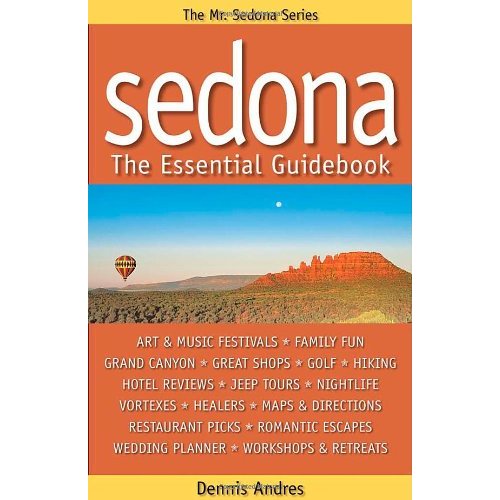
We drove 8 hours to Sedona today and had an uneventful trip (thank goodness). I’ve learned a lot about Sedona from all of the reading on the Internet and from a book called, “Sedona: The Essential Guidebook” by Dennis Andres that I picked out from Amazon.com. Sedona is located in the Oak Creek Canyon area in a transition zone between the high, snowy country of the Colorado Plateau and the vast, dry Sonoran Desert. It is considered “high desert.”

According to Andres, Sedona got its name in 1902 from Missouri brothers that settled in Oak Creek Canyon named Ellsworth and T. Carl Schnebly. When writing to the U.S. Postal Service to petition for a town post office, T. Carl suggested names of “Oak Creek Crossing” or “Schnebly Station” but the USPS wanted something shorter that would fit on a cancellation stamp. As a result, Ellsworth suggested they use T. Carl’s wife’s name: "Sedona."

Before the first settlers, though, the Native American people resided in the area more than 5,000 years ago. They survived by gathering nuts and berries in the forests as well as hunting wild game. There were acorns, prickly pears, and pine nuts to collect and quail, rabbits, and deer to hunt. Most likely, these people moved with the seasons, between the red rocks and the Colorado Plateau to the north. About 2,000 years ago, the people adopted farming and settled there.

The Native American people are known as the Sinagua (sin-a-wa), the word coming from the Spanish words “sin” (without) and “agua” (water).I hope we’ll get to visit the Sinagua ruins of Palatki with 12,000-year-old petroglyphs or Montezuma Castle (neither a castle nor associated with Montezuma) with its cliff dwellings.

Monday, July 5, 2010

Sedona's Vortexes

Soon we'll be taking our summer vacation to Sedona, AZ with side trips to Flagstaff and the Grand Canyon. I've never been to Sedona before and have only driven through Flagstaff on the way to California. I have been to the Grand Canyon, though, once when I was about 9 years old on a trip from California to Oklahoma with my mom's parents, and again when I was 28 and pregnant with my first child. I had such morning (daytime) sickness during that trip that I don't remember much except that I just wanted to stay in the car and be miserable. So this time, there is nothing to prevent me from enjoying the beauty around me and I look forward to seeing "That Big Hole in the Ground" as my grandpa, Pop, called it.

So I've been doing a bit of research online and have found many websites that describe Sedona and the Red Rocks the area is known for. I've learned that Sedona is known not only for it's geological beauty, but also for it's "Vortexes." The vortexes in Sedona are swirling centers of subtle energy coming out from the surface of the earth. It seems that visitors to certain areas around Sedona have experienced strong feelings such as an increase in intuition to a sense of being at home. People who claim that they are more sensitive to energy have reported that they are moved spontaneously to emotion or they feel unusually healthy and vibrant when in the presence of a vortex. Juniper trees are especially suseptable to the power of vortexes (photo, below left). Their trunks twist because of the energy (according to Sedona's spiritual leaders; I imagine botanists have another explanation).

According to the website lovesedona.com:
"There are four main energy vortexes in Sedona. The subtle energy that exists at these locations interacts with who a person is inside. The energy resonates with and strengthens the Inner Being of each person that comes within about a quarter to a half mile of it. This resonance happens because the vortex energy is very similar to the subtle energy operating in the energy centers inside each person. If you are at all a sensitive person, it is easy to feel the energy at these vortexes."
Now, these feelings may just be due to being in the presence of beautiful rock formations and as a geologist, I sure do love to be among beautiful rocks. But increased energy? Spirituality? Healing? I'll believe it if it happens to me!

So is there anything scientific to this perceived power? Some people said that it is the iron in the rocks that has not only colored them red, but has created magnetism that provides the power of the vortexes. But geological study has demonstrated that magnetism is not the source of the phenomenon that people report.

I guess the only way I'll find out is to go stand on one of these four vortexes or walk a trail leading to an energy spot and see what happens. At the very least (and what I'd expect) I'd find myself in a beautiful spot enjoying the views around me. And I guess that is spiritual in itself.